Anonymous
The Song of Roland
The Song of Roland
Couldn't load pickup availability
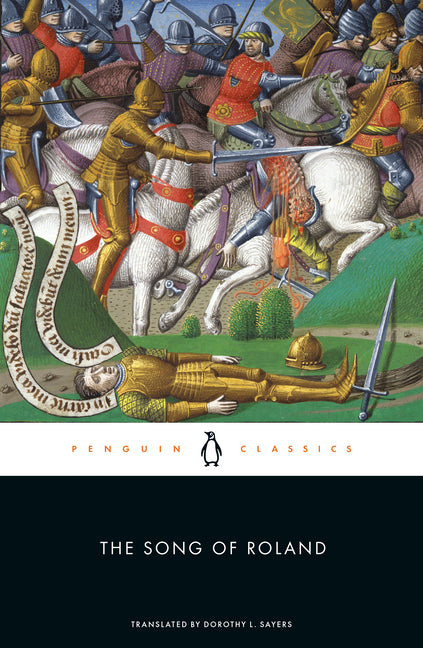
What does it mean to die for honor? The Song of Roland—the oldest surviving epic poem in French—transforms a historical skirmish into a legendary tale of heroism, loyalty, and martyrdom. On August 15, 778, Charlemagne's rearguard was ambushed in the Pyrenees while returning from Spain. Out of this event arose the story of Roland, Charlemagne's nephew and Lord of the Breton Marches, who refuses to call for help even as his outnumbered forces face annihilation. His pride, courage, and unwavering commitment to honor lead to his death and the massacre of his men—but also to immortal glory. Written by an unknown poet around 1100, this chanson de geste (song of heroic deeds) became the defining epic of medieval France.
The poem presents Roland's last stand as the ultimate expression of feudal values: loyalty to one's lord, courage in battle, and honor above survival. Roland's refusal to blow his horn (the oliphant) to summon Charlemagne until it's too late is both his tragic flaw and his greatest virtue—he will not be seen as weak or cowardly, even if it costs him his life. The battle becomes a symbolic struggle between Christianity and Islam, good and evil, with Roland and his companion Oliver representing different aspects of heroism: Roland embodies reckless courage and honor, while Oliver represents wisdom and prudence. Their friendship and their deaths reveal the tension between individual glory and collective survival, between pride and humility.
For contemplative readers, The Song of Roland offers profound meditation on pride, sacrifice, and the cost of unwavering commitment to ideals. The poem asks: When does honor become pride? What is the difference between courage and recklessness? How do we discern between dying for something meaningful and dying for ego? What do we owe to those who depend on us when our choices affect their survival? Roland's story becomes a mirror for examining our own relationship to pride, honor, and the ways our commitments can both elevate and destroy us. The poem's elegiac tone—celebrating Roland's glory while mourning the unnecessary deaths—suggests that the contemplative life requires holding both admiration for courage and awareness of its costs, both honoring sacrifice and questioning whether it was necessary.
What You'll Discover
- The oldest surviving epic poem in French (c. 1100, anonymous)
- Roland's last stand at Roncevaux Pass and his refusal to call for help
- The friendship between Roland (courage) and Oliver (wisdom)
- Charlemagne's grief and vengeance for his fallen warriors
- Medieval feudal values: loyalty, honor, courage, and martyrdom
- Contemplative insights into pride, sacrifice, and the cost of unwavering ideals
- The chanson de geste tradition and the foundation of French epic poetry
The Song of Roland shaped European literature and culture for centuries, influencing everything from chivalric romance to national identity. The poem's majestic verses celebrate heroism while revealing its tragic dimensions—Roland achieves immortal glory but at the cost of his life and the lives of those who trusted him. This Penguin Classics edition provides an authoritative translation with scholarly introduction and notes, making this foundational medieval epic accessible to contemporary readers.
Perfect for: Readers of medieval literature and epic poetry, contemplative readers exploring pride, sacrifice, and the cost of ideals, students of French literature and chanson de geste, those interested in feudal values and chivalric culture, anyone drawn to stories that examine the tension between honor and wisdom, courage and recklessness.
Paperback edition. The oldest French epic—Roland's heroic last stand becomes a meditation on pride, sacrifice, and the cost of unwavering commitment to honor, offering contemplative wisdom on discerning between courage and recklessness, glory and ego.
Share