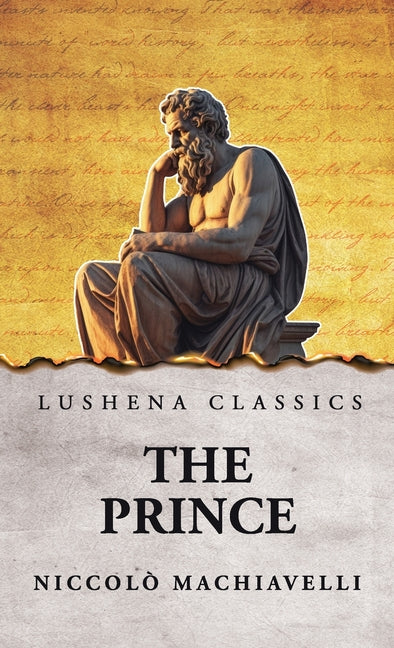
Niccolò Machiavelli
The Prince
The Prince
Couldn't load pickup availability
How should power be wielded? Niccolò Machiavelli's The Prince (1513) is the most famous—and infamous—treatise on political power ever written. Written as advice to Lorenzo de' Medici on how to rule, this slim work revolutionized political thought by separating politics from morality and focusing ruthlessly on what actually works rather than what ought to be. Machiavelli argues that a prince must be willing to act immorally when necessary, that it is better to be feared than loved, that appearances matter more than reality, and that the ends justify the means. This is political realism stripped of idealism: power is amoral, and those who refuse to recognize this will be destroyed by those who do.
Machiavelli draws on historical examples—Cesare Borgia, Moses, Romulus, ancient Rome—to demonstrate his principles. A prince must know when to use force and when to use cunning, when to keep promises and when to break them, when to appear merciful and when to be ruthless. Virtue (virtù) is not moral goodness but the skill and strength to seize and maintain power. Fortune (fortuna) is unpredictable, but a bold prince can master it. The work is shocking not because Machiavelli advocates cruelty for its own sake but because he describes power as it actually operates—without the comforting fiction that rulers are guided by justice or divine will. He reveals the gap between how we think politics should work and how it actually does.
For contemplative readers, The Prince offers profound meditation on power, pragmatism, and the relationship between means and ends. The work asks: When is it acceptable to act immorally for a greater good? How do we discern between necessary pragmatism and corruption? What is the cost of wielding power without moral constraint? How do we maintain integrity when the world rewards ruthlessness? The Prince becomes a mirror for examining our own relationship to power, ambition, and the ways we justify our actions. Machiavelli's genius lies in forcing us to confront uncomfortable truths: that ideals often fail in practice, that good intentions don't guarantee good outcomes, and that refusing to acknowledge how power works doesn't make us virtuous—it makes us naive. The contemplative challenge is not to become Machiavellian but to understand power clearly while choosing how to wield it responsibly.
What You'll Discover
- Machiavelli's revolutionary treatise on political power and statecraft (1513)
- Pragmatic advice on gaining, maintaining, and consolidating authority
- The separation of politics from morality: what works vs. what ought to be
- Key concepts: virtù (skill/strength), fortuna (fortune), fear vs. love, ends vs. means
- Historical examples: Cesare Borgia, Moses, Romulus, ancient Rome
- Contemplative insights into power, pragmatism, and the gap between ideals and reality
- Foundational text of political realism and Renaissance political thought
The Prince has been both celebrated and condemned for five centuries. It shaped modern political science, influenced rulers and revolutionaries, and gave us the term "Machiavellian." The work's power lies in its unflinching honesty about how power operates, forcing readers to confront the tension between moral ideals and political necessity.
This hardcover edition preserves Machiavelli's masterwork, offering readers access to one of the most influential and controversial works of political philosophy ever written.
Perfect for: Readers of political philosophy and Renaissance literature, contemplative readers exploring power and pragmatism, students of Machiavelli and political realism, those interested in leadership and statecraft, anyone examining the relationship between means and ends, readers seeking to understand how power actually operates vs. how we think it should.
Hardcover edition. Machiavelli's revolutionary treatise on political power—offering contemplative wisdom on pragmatism, the gap between ideals and reality, and understanding power clearly while choosing how to wield it responsibly.
Share