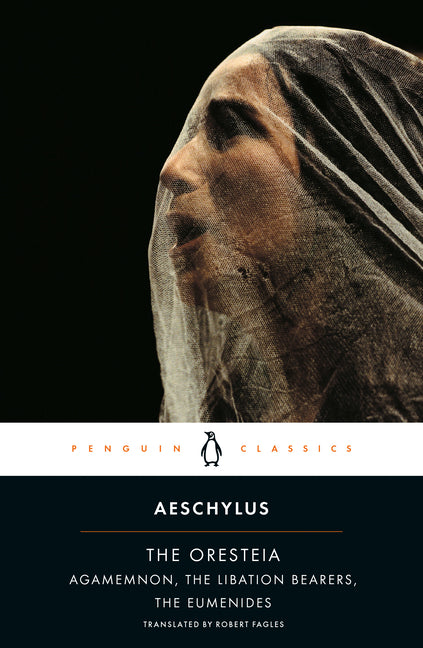
Aeschylus
The Oresteia
The Oresteia
Couldn't load pickup availability
What is justice, and how do we break the cycle of violence and revenge? The Oresteia is the only complete tragic trilogy to survive from ancient Greece—a monumental work by Aeschylus that stands as one of the supreme achievements of Western drama. First performed in Athens in 458 BCE, the trilogy traces the curse on the House of Atreus through three generations of bloodshed, exploring the nature of justice, the conflict between divine and human law, and the transformation from primitive blood vengeance to civilized legal order. Through the intertwined fates of Agamemnon, Clytemnestra, Orestes, and the city of Athens itself, Aeschylus creates a profound meditation on guilt, responsibility, the demands of the gods, and the possibility of breaking cycles of violence through reason and civic institutions.
The trilogy unfolds across three plays, each a masterpiece in its own right. In Agamemnon, the victorious king returns from Troy only to be murdered by his wife Clytemnestra, who seeks revenge for his sacrifice of their daughter Iphigenia and his infidelity with Cassandra. The play explores the terrible cost of the Trojan War, the corruption of power, and the justice of Clytemnestra's claim that she has avenged her daughter. In The Libation Bearers (Choephoroi), Orestes returns from exile to avenge his father by killing his mother and her lover Aegisthus, caught in an impossible dilemma where honoring his father requires matricide. In The Furies (Eumenides), Orestes is pursued by the Erinyes (Furies), ancient goddesses of vengeance who demand blood for blood. He flees to Athens, where Athena establishes the first court of law, the Areopagus, to try his case—transforming the cycle of revenge into a system of justice based on reason, evidence, and civic deliberation.
For contemplative readers, The Oresteia offers profound meditation on the nature of justice, the weight of inherited guilt, and the possibility of social and moral progress. The work asks: How do we break cycles of violence that span generations? What is the relationship between divine law and human justice? Can reason and civic institutions replace blood vengeance? How do we balance competing claims of justice when all parties have legitimate grievances? What is the cost of progress, and how do we honor the old gods while creating new forms of order? How do individuals bear the weight of family curses and historical crimes? The trilogy becomes a meditation on the birth of democracy, the rule of law, and the human capacity to transform suffering into wisdom—themes that remain urgently relevant to our own struggles with justice, violence, and reconciliation.
What You'll Discover
- The only complete Greek tragic trilogy that survives from antiquity
- Three plays: Agamemnon, The Libation Bearers, and The Furies
- The curse on the House of Atreus and three generations of bloodshed
- The transformation from blood vengeance to civic justice and the rule of law
- Profound exploration of guilt, responsibility, and inherited violence
- The founding of the Areopagus court and the birth of Athenian democracy
- Aeschylus' majestic poetry and dramatic power
- One of the foundational works of Western literature and drama
Aeschylus (c. 525–456 BCE) is known as the father of Greek tragedy, credited with transforming drama from ritual performance into a sophisticated art form exploring the deepest questions of human existence. He fought at the Battle of Marathon and witnessed the birth of Athenian democracy, experiences that profoundly shaped his vision of justice and civic order. Of his estimated 70-90 plays, only seven survive complete, with The Oresteia standing as his masterpiece. This Penguin Classics edition presents the complete trilogy with scholarly introduction and notes, making this monumental work accessible to contemporary readers while preserving its dramatic power and philosophical depth.
Perfect for: Students of classical literature and Greek drama, readers exploring the foundations of Western theater, those interested in the origins of justice and democratic institutions, contemplative readers drawn to themes of guilt, revenge, and redemption, scholars of tragedy and ancient philosophy, anyone seeking profound meditation on violence, law, and the possibility of breaking destructive cycles, readers who love epic narratives of family, fate, and the gods.
Paperback edition. Aeschylus' monumental trilogy—offering contemplative wisdom on justice, revenge, and the transformation from blood vengeance to civic law through the only complete Greek tragic trilogy to survive from antiquity.
Share