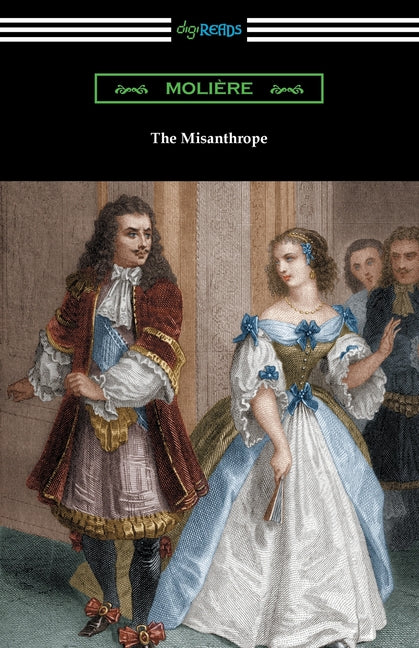
Moliere
The Misanthrope
The Misanthrope
Couldn't load pickup availability
What is the cost of absolute honesty in a world built on social niceties, and can we love someone who embodies everything we claim to despise? The Misanthrope is Molière's brilliant comedy of manners—a witty and sophisticated exploration of authenticity, hypocrisy, and the contradictions of the human heart. First performed in 1666, the play satirizes both the superficiality of French aristocratic society and the rigidity of those who reject all social convention in the name of truth. Through sparkling dialogue, complex characters, and keen psychological insight, Molière creates a comedy that is as intellectually satisfying as it is entertaining, asking profound questions about the relationship between honesty and tact, principle and compromise, love and self-knowledge.
The play centers on Alceste, a gentleman who despises the hypocrisy, flattery, and false politeness of Parisian society and insists on speaking the unvarnished truth at all times, regardless of social consequences. Yet Alceste finds himself hopelessly in love with Célimène, a young widow who delights in the very social games he condemns—she is charming, flirtatious, witty, and thoroughly enjoys the attention of multiple suitors. As Alceste struggles with this contradiction between his principles and his heart, Molière explores the comedy and tragedy of being too honest in a world that runs on polite deception, and the question of whether absolute integrity is a virtue or a form of pride. The result is a play that makes us laugh while forcing us to examine our own compromises between truth and social harmony.
For contemplative readers, The Misanthrope offers profound meditation on authenticity, social convention, and the complexity of human relationships. The work asks: Is absolute honesty always virtuous, or can it be a form of cruelty or self-righteousness? How do we balance truth-telling with compassion and social harmony? What does it mean to love someone whose values contradict our own? Is it possible to live in society while rejecting its conventions, or must we find some middle ground? What is the difference between genuine integrity and rigid inflexibility? How do we navigate the tension between being true to ourselves and getting along with others? The play becomes a timeless exploration of the human need for both authenticity and connection, and the difficulty of achieving both simultaneously.
What You'll Discover
- Molière's masterpiece of comedy of manners and social satire
- The story of a brutally honest man in love with a woman who embodies social artifice
- Witty dialogue and sophisticated exploration of authenticity vs. convention
- Satire of both social hypocrisy and rigid honesty
- Themes of love, integrity, compromise, and self-knowledge
- Complex characters who defy simple moral judgments
- Henri Van Laun translation with introduction by Eleanor F. Jourdain
- One of the most intellectually engaging comedies in world theater
Molière (Jean-Baptiste Poquelin, 1622–1673) drew upon his bourgeois upbringing and years performing with traveling theater troupes to create comedies that brilliantly satirized French society. The Misanthrope, first performed in 1666, is considered one of his finest achievements—a play that balances comedy with serious philosophical inquiry. Unlike his broader satires like Tartuffe, The Misanthrope presents characters with genuine complexity, making us sympathize with both the misanthrope's disgust at social hypocrisy and society's frustration with his inflexibility. The play's influence on comedy and social commentary has been profound, inspiring countless works that explore the tension between individual integrity and social harmony. This edition includes a scholarly introduction and is translated by Henri Van Laun, offering readers access to one of the wittiest and most thought-provoking plays in the theatrical canon.
Perfect for: Students of classical theater and French literature, readers who enjoyed Tartuffe and The Clouds, those interested in comedy of manners and social satire, contemplative readers exploring authenticity and social convention, anyone drawn to witty dialogue and complex characters, scholars of comedy and the history of theater, readers seeking intelligent entertainment that balances humor with philosophical depth.
Paperback edition. Molière's sophisticated comedy—offering witty satire on honesty, hypocrisy, and the contradictions of the human heart through one of the most intellectually engaging and entertaining plays in world theater.
Share