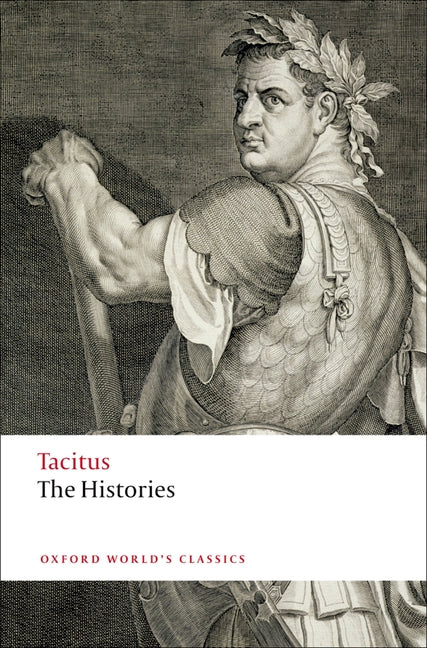
Tacitus
The Histories
The Histories
Couldn't load pickup availability
What happens when an empire tears itself apart? Tacitus's The Histories chronicles the catastrophic Year of the Four Emperors (AD 69)—a period when Rome descended into civil war following Nero's death, and four men claimed the throne in rapid succession through violence, betrayal, and military force. In just a few months, the empire that had conquered the known world nearly destroyed itself from within. Written with Tacitus's characteristic cynical power and moral seriousness, this is history as tragedy: the collapse of order, the triumph of ambition over virtue, and the human cost of political chaos.
Tacitus writes as a witness to the fragility of civilization. After Nero's suicide, the empire fractured: Galba, Otho, Vitellius, and finally Vespasian each seized power through force, while legions fought legions, cities burned, and the Senate became irrelevant. Tacitus reveals the psychology of civil war—how fear breeds violence, how loyalty becomes transactional, how soldiers choose emperors based on promises of plunder rather than principle. This is not triumphalist history but moral reckoning: what does it mean when the institutions meant to preserve order become instruments of destruction? When does survival require complicity in atrocity?
For contemplative readers, The Histories offers profound reflection on chaos, resilience, and the inner life during societal collapse. Tacitus asks questions that resonate across centuries: How do we maintain integrity when institutions fail? What does it mean to witness violence and remain human? How do we discern right action when all choices seem compromised? When does hope become delusion, and when does despair become surrender? The Histories becomes a meditation on living through catastrophe—not with false optimism but with clear-eyed awareness of what's happening and what remains within our control. Tacitus shows that the contemplative life is not escape from chaos but the capacity to see clearly within it, to maintain moral discernment when everything around us dissolves into violence and fear.
What You'll Discover
- The Year of the Four Emperors (AD 69)—Galba, Otho, Vitellius, and Vespasian's rise to power
- Civil war, military mutinies, and the collapse of political order in Rome
- Tacitus's brilliant psychological analysis of ambition, fear, and moral compromise
- The siege of Rome, battles between legions, and the burning of the Capitol
- The Flavian dynasty's emergence from chaos and Vespasian's consolidation of power
- Contemplative insights into integrity during collapse, moral discernment in chaos, and resilience
- A companion to The Annals—together they cover AD 14-96 of Roman imperial history
Tacitus (ca. 56-117 AD) is widely regarded as Rome's greatest historian for his unflinching moral vision and psychological depth. He writes not to celebrate Rome but to understand it—to reveal how power corrupts, how institutions fail, and how human nature responds to crisis. W.H. Fyfe's classic translation, substantially revised for this Oxford World's Classics edition, captures Tacitus's terse, epigrammatic prose and moral gravity.
This edition includes extensive historical and literary notes, an introduction examining Tacitus's writing and the political context, and scholarly apparatus to guide readers through one of the most dramatic periods in Roman history.
Perfect for: Readers of Roman history and classical literature, contemplative readers exploring integrity and resilience during societal collapse, students of political philosophy and the nature of power, those interested in civil war and institutional failure, anyone examining how to maintain moral clarity in chaotic times, readers of The Annals seeking to complete Tacitus's historical vision.
Paperback edition. Tacitus's masterwork on the Year of the Four Emperors—a moral witness to civil war and political collapse, offering contemplative wisdom on integrity, resilience, and clear seeing during catastrophe.
Share