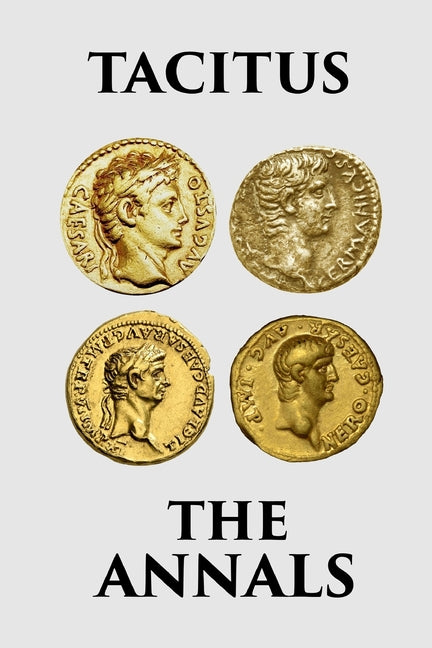
Tacitus
The Annals
The Annals
Couldn't load pickup availability
How does power corrupt? What happens when ambition, paranoia, and absolute authority converge in a single person? Tacitus's Annals chronicles the Roman Empire from the death of Augustus (AD 14) through the reigns of Tiberius, Claudius, and Nero—a period of political intrigue, moral decay, and the gradual erosion of republican virtue. Written by a Roman senator with access to official records, this is history as moral witness: unflinching, psychologically astute, and deeply concerned with the cost of tyranny to both rulers and ruled.
Tacitus writes with bitter clarity about the mechanisms of autocracy: the paranoia that drives emperors to murder rivals, the sycophancy that corrupts the Senate, the way fear silences dissent and virtue becomes dangerous. Through vivid portraits of emperors, generals, and conspirators, he reveals how power transforms people—Tiberius's descent into cruelty, Nero's theatrical madness, the courage of those who resist and the compromises of those who survive. This is not triumphalist history but a meditation on the fragility of freedom and the human capacity for both nobility and degradation under tyranny.
For contemplative readers, the Annals offers profound reflection on integrity, moral courage, and the inner life under oppressive systems. Tacitus asks questions that resonate across centuries: How do we maintain virtue when virtue is punished? What does it cost to speak truth to power? How do we discern between prudent silence and moral cowardice? When does survival become complicity? The Annals becomes a mirror for examining our own relationship to power, authority, and the choices we make when external circumstances demand compromise. Tacitus shows that the contemplative life is not retreat from politics but clear-eyed engagement with moral reality—understanding the forces that corrupt while refusing to be corrupted by them.
What You'll Discover
- The reigns of Tiberius, Claudius, and Nero (AD 14-68) from official Roman records
- Political intrigue, conspiracies, and the psychology of absolute power
- The great fire of Rome and Nero's persecution of Christians
- Military campaigns: Germanicus in Germany, the Parthian War, revolts in Britain under Caractacus and Boudica
- Roman society: slavery, citizenship, Senate politics, and the erosion of republican virtue
- Contemplative insights into integrity, moral courage, and maintaining virtue under tyranny
- Tacitus's brilliant psychological portraits and moral analysis of power's corrupting influence
Tacitus (ca. 56-117 AD) is widely regarded as Rome's greatest historian—not for neutrality but for moral seriousness. He writes as a senator who witnessed tyranny firsthand, and his prose combines narrative power with penetrating psychological insight. Alfred J. Church's translation captures Tacitus's terse, epigrammatic style and moral gravity, making this essential historical text accessible to contemporary readers.
This edition includes all original paragraph numbering, making it suitable for both academic study and contemplative reading of one of history's most important witnesses to the nature of power and the cost of empire.
Perfect for: Readers of Roman history and classical literature, contemplative readers exploring integrity and moral courage under oppressive systems, students of political philosophy and the nature of power, those interested in the psychology of tyranny and resistance, anyone examining the relationship between virtue and survival in difficult times.
Paperback edition. Tacitus's masterwork of Roman history—a moral witness to the reigns of Tiberius, Claudius, and Nero, offering contemplative wisdom on integrity, power, and the cost of maintaining virtue under tyranny.
Share