Paulo Freire
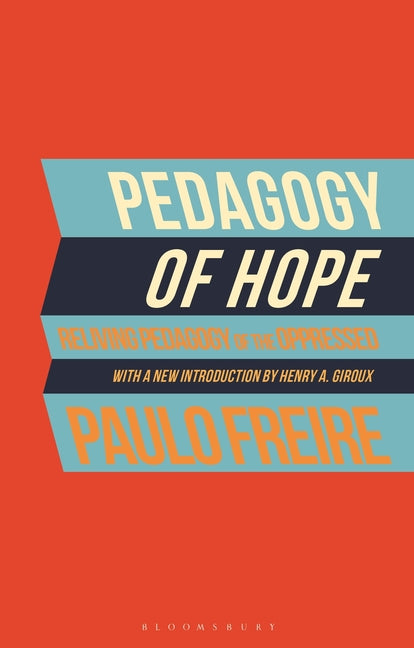
Pedagogy of Hope: Reliving Pedagogy of the Oppressed
Pedagogy of Hope: Reliving Pedagogy of the Oppressed
Couldn't load pickup availability
Paulo Freire's deeply personal and hopeful sequel to Pedagogy of the Oppressed—a reflective journey revisiting his revolutionary ideas through the lens of lived experience, political struggle, and unwavering faith in humanity's capacity for transformation and liberation.
Written nearly three decades after Pedagogy of the Oppressed, this companion volume finds Paulo Freire reflecting on the real-world impact of his ideas, the contexts that inspired them, and the lessons learned from decades of educational practice and political engagement. Pedagogy of Hope is both a memoir and a meditation—Freire revisits his masterwork not to revise it, but to deepen it through stories, reflections, and renewed commitment to education as a practice of freedom.
What you'll discover:
- Personal stories and contexts behind the ideas in Pedagogy of the Oppressed
- Reflections on exile, political struggle, and educational practice across continents
- How Freire's ideas have been applied, misunderstood, and transformed in practice
- The relationship between hope, critical consciousness, and social transformation
- Why hope is an ontological need—essential to human existence and struggle
- Responses to critics and clarifications of key concepts like dialogue and praxis
- The role of love, humility, and courage in liberating education
- Stories from Brazil, Chile, Africa, and beyond illustrating transformative pedagogy in action
This is not simply a theoretical update but a deeply human book. Freire shares stories of teaching literacy to peasants in Brazil, working with revolutionary governments in Africa, living in exile, and witnessing both the triumphs and betrayals of liberation movements. Through these narratives, he demonstrates that hope is not naive optimism but a disciplined commitment to possibility even in the face of overwhelming obstacles.
Freire's central message is that hope is an ontological need—as essential to human existence as oxygen. But hope requires critical consciousness and action; it must be grounded in reality and expressed through praxis. He writes with characteristic warmth, intellectual rigor, and profound faith in humanity's capacity to create a more just and humane world through education and collective struggle.
For Homeschool Educators:
While Freire wrote primarily about literacy education for marginalized populations, his core insights speak directly to the heart of homeschool philosophy. His rejection of the "banking model"—where teachers deposit knowledge into passive students—and his vision of education as dialogue perfectly describes the collaborative learning that happens in homeschool settings. When Freire writes about teachers and students learning together, discovering knowledge through conversation rather than transmission, he's describing what many homeschool families practice daily.
His concept of "conscientization"—developing critical consciousness rather than passive acceptance—aligns beautifully with homeschool values of nurturing independent thinkers who question assumptions and engage deeply with ideas. Many families choose homeschooling precisely to liberate their children from educational systems they see as dehumanizing or standardized, making Freire's liberation pedagogy deeply relevant to their educational philosophy. His emphasis on education as humanization—developing agency, dignity, and the capacity to shape one's world—resonates with homeschool approaches that prioritize character formation, the whole child, and education for life rather than merely college preparation.
This book offers homeschool educators a philosophical foundation for understanding why dialogue-based, student-centered learning works, and why education grounded in hope, love, and critical consciousness produces not just knowledgeable students but fully human beings capable of transforming their world.
This edition includes a substantial new introduction by Henry A. Giroux, one of the leading scholars of critical pedagogy, who contextualizes Freire's work for contemporary readers and demonstrates its enduring relevance to current educational and social justice struggles.
Perfect for: Readers of Pedagogy of the Oppressed seeking deeper context and reflection, educators committed to transformative pedagogy, students of critical pedagogy and liberation theology, social justice activists and community organizers, homeschool educators exploring alternative educational philosophies, those interested in the intersection of education and political struggle, readers seeking hope grounded in critical consciousness rather than naive optimism, and anyone inspired by Freire's vision of education as humanization and liberation.
This paperback edition presents Paulo Freire's reflective companion to his revolutionary masterwork—a testament to hope as an ontological need and education as a practice of freedom. Translated by Robert R. Barr.
Share