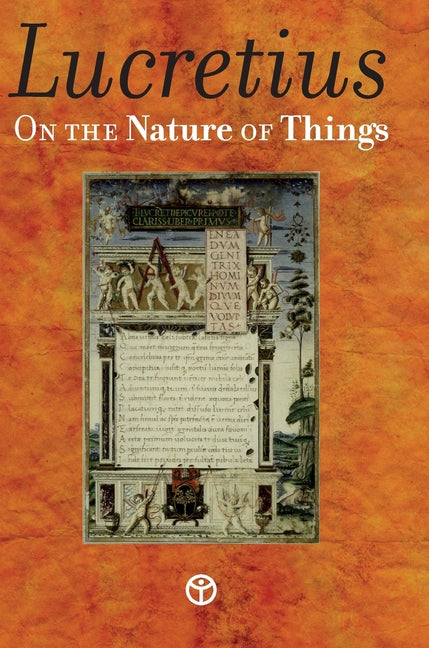
Titus Lucretius
On the Nature of Things: De Rerum Natura
On the Nature of Things: De Rerum Natura
Couldn't load pickup availability
What is the nature of reality? Lucretius' On the Nature of Things (De Rerum Natura, 1st century BCE) is one of the most extraordinary philosophical poems in world literature—a comprehensive exposition of Epicurean philosophy presented in sublime Latin verse. Written to liberate readers from fear of death, divine punishment, and superstition, Lucretius explains the atomic structure of the universe, the mortality of the soul, the natural causes of phenomena once attributed to gods, and the path to tranquility through understanding. The poem is simultaneously a scientific treatise (explaining atomism, physics, biology, and cosmology), a work of profound poetry, and a guide to living without anxiety. Lucretius argues that the universe operates by natural law, not divine caprice—that understanding nature's mechanisms frees us from irrational fears and opens the way to peace.
Lucretius organizes his six-book poem to cover the fundamental principles of Epicurean physics and ethics. He explains that everything is composed of atoms moving through void, that the soul is material and dies with the body, that the gods (if they exist) are unconcerned with human affairs, and that natural phenomena have physical causes. He describes the formation of worlds, the evolution of life, the development of civilization, and the nature of sensation, thought, and emotion. Throughout, Lucretius uses vivid imagery—the dance of atoms like dust motes in sunlight, the swerve (clinamen) that introduces freedom into deterministic nature, the plague of Athens as metaphor for spiritual sickness. His purpose is therapeutic: to show that death is nothing to fear (we won't exist to experience it), that the universe is not governed by angry gods, and that pleasure and peace come from understanding nature and living simply.
For contemplative readers, On the Nature of Things offers profound meditation on mortality, fear, and the art of living with acceptance. The work asks: What is the nature of reality, and how does understanding it bring peace? How do we overcome fear of death and divine punishment? What does it mean to live in a universe governed by natural law rather than divine will? How do we find tranquility in the face of our mortality? What is the relationship between knowledge of nature and inner peace? Lucretius' poem becomes a guide to contemplative materialism—not nihilism but liberation through understanding, acceptance of our place in the natural order, and cultivation of simple pleasures and friendships that make mortal life worth living.
What You'll Discover
Lucretius' poetic exposition of Epicurean philosophy (1st century BCE)
Atomic theory: the structure of reality and the dance of atoms
The mortality of the soul and freedom from fear of death
Natural explanations for phenomena once attributed to gods
The evolution of life, civilization, and human culture
Contemplative insights into mortality, fear, and living with acceptance
A masterpiece that influenced the scientific revolution and Renaissance thought
Titus Lucretius Carus (c. 99-55 BCE) was a Roman poet and follower of Epicurus whose De Rerum Natura is the most complete surviving exposition of Epicurean philosophy. Rediscovered in 1417 after being lost for centuries, the poem profoundly influenced Renaissance thinkers and the scientific revolution, offering an atomistic, mechanistic view of nature as an alternative to Aristotelian physics. This edition presents William Ellery Leonard's classic 1916 translation, which captures both the philosophical depth and poetic beauty of Lucretius' Latin verse.
Perfect for: Readers of classical philosophy and ancient poetry, students of Epicureanism and Hellenistic thought, contemplative readers exploring mortality and the nature of reality, those interested in the history of science and atomism, anyone seeking freedom from fear of death through philosophical understanding, readers drawn to works that combine poetry with profound ideas, students of the scientific revolution and Renaissance humanism.
Hardcover edition. Lucretius' philosophical masterpiece on the nature of reality—offering contemplative wisdom on atoms and the void, the mortality of the soul, freedom from fear, and finding peace through understanding the natural world.
Share