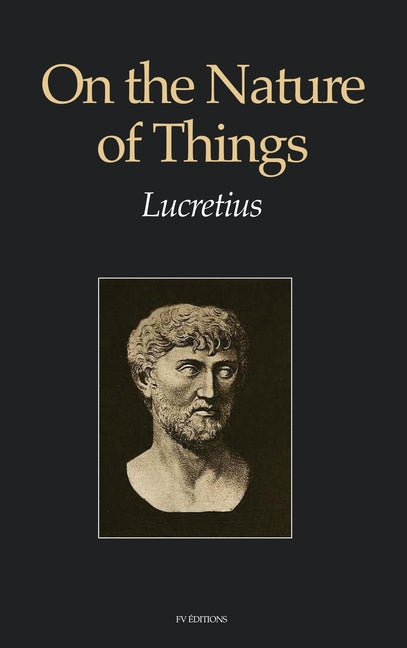
Lucretius
On the Nature of Things
On the Nature of Things
Couldn't load pickup availability
What is the nature of reality? Can we live without fear of death and divine punishment? How do we find peace in a universe governed by natural law rather than capricious gods? Lucretius's De Rerum Natura (On the Nature of Things) is a philosophical epic that introduces Roman readers to Epicurean thought through 7,400 lines of stunning poetry. Written in the first century BCE, this work explores atomism, the nature of mind and soul, the mechanics of sensation and thought, and the origins of the world—all in service of a radical vision: that understanding nature frees us from superstition, fear, and the tyranny of false beliefs.
Lucretius writes with passionate conviction that "nothing can be produced from nothing"—the universe operates according to natural principles, not divine whim. Atoms move through void, combining and separating to create everything we see. The soul is material and mortal, dissolving at death. The gods, if they exist, are indifferent to human affairs. Thunder is not Zeus's anger but atmospheric phenomena. This is not nihilism but liberation: if death is annihilation, there's nothing to fear; if gods don't intervene, we're free to live according to reason and pleasure rather than superstition and dread.
For contemplative readers, On the Nature of Things offers profound meditation on impermanence, the nature of mind, and freedom from fear. Lucretius's atomism anticipates Buddhist insights into the composite, impermanent nature of all phenomena—nothing has fixed essence, everything arises and passes away. His exploration of how false beliefs create suffering mirrors contemplative traditions' emphasis on seeing reality clearly. The poem asks: What changes when we understand that we are temporary arrangements of matter in an infinite universe? How do we live well when nothing lasts? What does it mean to be free from the fear of death and divine punishment? On the Nature of Things becomes a contemplative practice in itself—training the mind to see nature as it is, not as we fear it to be, and finding peace in that clear seeing.
What You'll Discover
- Epicurean philosophy presented through richly poetic dactylic hexameter
- The principles of atomism—nothing comes from nothing, everything is atoms and void
- The nature of mind and soul as material and mortal, dissolving at death
- How sensation, thought, and consciousness arise from atomic interactions
- Natural explanations for celestial and terrestrial phenomena (thunder, earthquakes, seasons)
- Contemplative insights into impermanence, freedom from fear, and living according to nature
- A radical vision of liberation through understanding reality as it is
Lucretius's genius lies in making complex philosophy accessible and beautiful. His metaphors—atoms like letters forming words, the mind like a vessel that can be filled or emptied—illuminate abstract concepts through vivid imagery. This is philosophy as poetry, science as spiritual practice, reason as path to peace.
This hardcover edition preserves Lucretius's masterwork, offering readers access to one of the most important philosophical poems in Western literature—a text that influenced the Renaissance, the Enlightenment, and continues to speak to anyone seeking to understand nature and live without fear.
Perfect for: Readers of classical philosophy and ancient literature, contemplative readers exploring impermanence and freedom from fear, students of Epicureanism and atomism, those interested in the intersection of science and philosophy, anyone drawn to poetry that illuminates the nature of reality and offers a path to peace.
Hardcover edition. Lucretius's philosophical epic on the nature of reality—a stunning work of poetry and Epicurean thought offering contemplative wisdom on impermanence, freedom from fear, and living according to nature.
Share