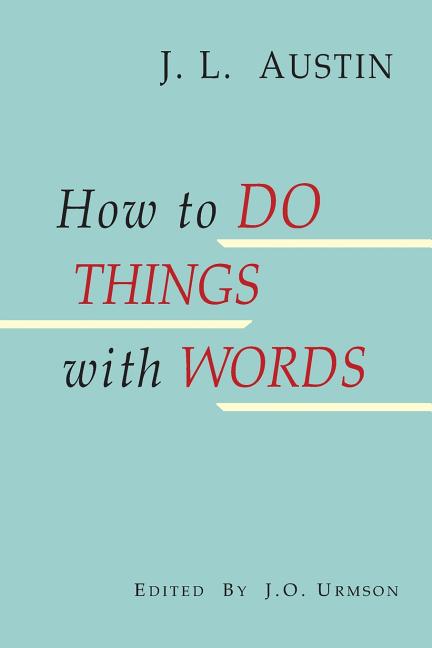
J. L. Austin
How to Do Things with Words
How to Do Things with Words
Couldn't load pickup availability
J.L. Austin's How to Do Things with Words stands as one of the most influential works in twentieth-century philosophy of language, revolutionizing our understanding of how language functions in human life by demonstrating that speaking is not merely describing reality but actively shaping it.
Based on Austin's 1955 William James Lectures at Harvard and published posthumously in 1962, this groundbreaking work introduces the theory of speech acts—the insight that utterances like "I promise," "I apologize," or "I pronounce you married" are not statements about the world but actions that change social reality. Austin's careful analysis reveals that language is fundamentally performative: we use words not just to say things but to do things—to make promises, issue warnings, perform ceremonies, and create obligations.
What distinguishes Austin's approach is his meticulous attention to ordinary language and everyday examples. Rather than constructing abstract theories, he examines how people actually use language in concrete situations, revealing subtle distinctions and complexities that formal logic overlooks. His method exemplifies the "ordinary language philosophy" movement at Oxford, which insisted that philosophical problems often arise from misunderstanding how language actually works.
Key Themes:
- Speech acts: locutionary, illocutionary, and perlocutionary acts
- Performative utterances vs. constative statements
- Felicity conditions: what makes speech acts succeed or fail
- The distinction between saying and doing with words
- Explicit and implicit performatives
- The social and conventional dimensions of language
- Critique of the descriptive theory of meaning
Why This Text Matters:
Austin's theory of speech acts has transformed multiple disciplines beyond philosophy—linguistics, literary theory, anthropology, law, and communication studies all draw on his insights. His recognition that language creates social reality rather than merely describing it has profound implications for understanding power, authority, ritual, and human relationships. The work challenges the assumption that language's primary function is to represent facts, revealing instead that speaking is a form of action embedded in social practices and institutions.
This accessible and elegantly written text remains essential reading for anyone interested in how language works, how meaning emerges from use, and how words shape the world we inhabit.
Ideal for: Students of analytic philosophy and philosophy of language, linguists and communication scholars, literary theorists, anyone interested in how language creates social reality, readers of Wittgenstein and ordinary language philosophy, and those exploring the relationship between words and action.
Quality paperback edition. A foundational text in philosophy of language and a cornerstone of any serious philosophical library.
Share