William McCarthy
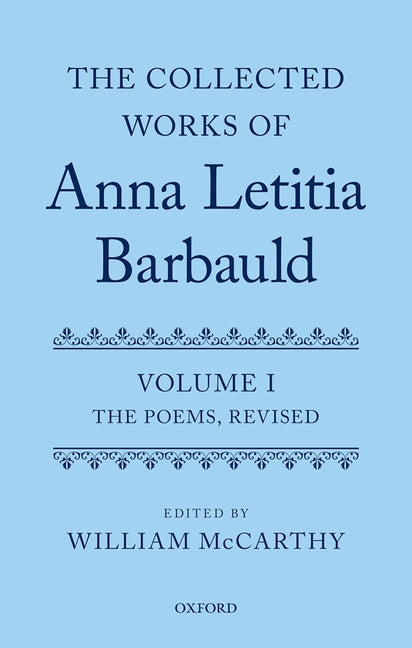
Collected Works of Anna Letitia Barbauld: Anna Letitia Barbauld: The Poems, Revised: Volume I
Collected Works of Anna Letitia Barbauld: Anna Letitia Barbauld: The Poems, Revised: Volume I
Couldn't load pickup availability
What is the voice of enlightened reason and moral conscience? Anna Laetitia Barbauld's Collected Works: The Poems presents the complete poetical works of one of the most influential writers of the Romantic era—a woman of letters whose career spanned poetry, essays, literary criticism, children's literature, and political commentary. Barbauld (1743-1825) wrote with intellectual rigor and moral seriousness, combining Enlightenment rationalism with Romantic sensibility to create poetry that addresses nature, politics, education, religion, and social justice. Her work influenced Coleridge and Wordsworth, helped establish the canon of English literature, and demonstrated that women could be publicly engaged in political and intellectual life. This definitive Oxford edition presents all her known poems, including newly discovered works, making it the essential resource for understanding Barbauld's literary achievement.
Barbauld's poetry ranges from hymns and devotional verse to political poems critiquing war and injustice, from nature lyrics to innovative works for children. Her most famous poem, Eighteen Hundred and Eleven (1812), boldly criticized Britain's participation in the Napoleonic Wars and prophesied the decline of the British Empire—earning vicious reviews that ended her public writing career. Her earlier works celebrate nature, reason, and moral improvement; her hymns explore faith and divine presence; her political poems advocate for religious liberty, abolition, and peace. Barbauld writes with clarity, intelligence, and moral conviction, balancing emotional depth with intellectual precision. Her voice is that of an engaged citizen and thoughtful believer, using poetry to illuminate truth and promote justice.
For contemplative readers, Barbauld's poetry offers profound meditation on reason, conscience, and moral responsibility. Her work asks: How do we balance reason and emotion, intellect and faith? What are our obligations to justice and the common good? How do we speak truth to power despite consequences? What is the relationship between education and moral development? Barbauld's verse becomes a companion for ethical contemplation—modeling intellectual courage, moral clarity, and the conviction that poetry can serve both beauty and truth, art and justice.
What You'll Discover
Barbauld's complete poems in the definitive scholarly edition (1743-1825)
Political poetry including Eighteen Hundred and Eleven
Hymns, nature lyrics, and innovative children's verse
Poems on education, religion, abolition, and social justice
Contemplative insights into reason, conscience, and moral responsibility
The voice that influenced Coleridge, Wordsworth, and Romantic poetry
Anna Laetitia Barbauld (1743-1825) was a poet, essayist, literary critic, educator, and advocate for religious and political reform. Her innovative children's literature influenced pedagogy for over a century, her literary criticism helped establish the English novel canon, and her political writings demonstrated women's capacity for public intellectual engagement. Though largely forgotten in the twentieth century, feminist literary scholarship has restored her place as a major figure in British Romanticism and women's literary history. This Oxford edition, edited by William McCarthy, is the authoritative text for all students of Barbauld's work.
Perfect for: Readers of Romantic poetry and women's literature, students of Anna Laetitia Barbauld and British Romanticism, contemplative readers exploring reason and moral conscience, those interested in women's intellectual history and early feminism, scholars and serious poetry readers seeking the definitive edition, readers of political poetry and social justice literature, students of Enlightenment and Romantic thought.
Hardcover scholarly edition. Barbauld's complete poems—offering contemplative wisdom on reason, conscience, and moral responsibility through the intellectually rigorous and morally courageous voice of a pioneering woman of letters.
Share