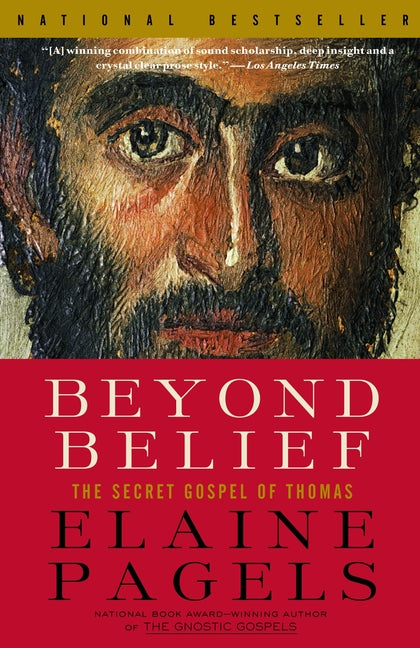
Elaine Pagels
Beyond Belief: The Secret Gospel of Thomas
Beyond Belief: The Secret Gospel of Thomas
Couldn't load pickup availability
Elaine Pagels's groundbreaking exploration of the Gospel of Thomas and early Christian diversity—a scholarly yet deeply personal journey into how this ancient text challenges orthodox Christianity, celebrates spiritual questioning, and reveals a mystical vision of finding the divine light within, offering profound insights into the origins of Christian faith and the ongoing quest for authentic spirituality.
Elaine Pagels, the renowned Princeton religious scholar and bestselling author of The Gnostic Gospels, published Beyond Belief in 2003, weaving together rigorous scholarship with her own spiritual journey. The book examines the Gospel of Thomas—a collection of Jesus's sayings discovered in 1945 at Nag Hammadi, Egypt—and explores why it was excluded from the New Testament while the Gospel of John was included. Through this investigation, Pagels reveals the rich diversity of early Christianity and argues for the value of ongoing questioning and multiple interpretations of faith.
What you'll discover:
- The Gospel of Thomas and its mystical emphasis on finding "the light within"
- Why early church leaders chose the Gospel of John over Thomas for the canon
- The diversity of early Christian communities and their varied interpretations of Jesus's teachings
- How orthodoxy emerged through excluding alternative voices and texts
- The tension between institutional authority and individual spiritual experience
- Pagels's personal journey through grief and her search for authentic faith
- The value of questioning, doubt, and diverse interpretations in spiritual life
- How the Gospel of Thomas speaks to contemporary seekers
Pagels argues that the Gospel of Thomas presents a more mystical, inward-focused Christianity—emphasizing direct spiritual experience and the divine light within each person—while the Gospel of John emphasizes belief in Jesus as the unique Son of God and the authority of the church. Early church leaders chose John because it supported institutional authority and doctrinal uniformity, while Thomas encouraged individual spiritual exploration and diverse interpretations. Yet Pagels suggests that both perspectives have value and that Christianity is richer when it embraces questioning and diversity rather than demanding conformity.
What makes this book essential for your contemplative library is its combination of rigorous scholarship and personal spiritual inquiry. Pagels doesn't attack Christianity but invites readers to explore its origins with honesty and openness. She weaves her own story—including the tragic death of her young son—into the narrative, showing how her scholarly work became deeply personal as she grappled with grief, faith, and the search for authentic spirituality. The result is both intellectually compelling and emotionally moving.
The Gospel of Thomas itself contains beautiful, enigmatic sayings that invite contemplation: "If you bring forth what is within you, what you bring forth will save you. If you do not bring forth what is within you, what you do not bring forth will destroy you." Pagels explores how these teachings emphasize self-knowledge, inner light, and direct spiritual experience—themes that resonate with mystical traditions across religions and speak to contemporary seekers questioning institutional religion.
Perfect for: Readers interested in early Christianity and the origins of the New Testament, students of the Gospel of Thomas and Gnostic texts, those questioning orthodox Christianity while seeking authentic faith, readers interested in Christian mysticism and inner spiritual experience, anyone exploring the relationship between institutional religion and personal spirituality, students of religious history and the formation of canon, readers of Elaine Pagels and scholarly religious writing, and contemplative seekers drawn to questioning, diversity, and the recognition of divine light within.
This paperback edition presents Elaine Pagels's groundbreaking work—a scholarly yet deeply personal exploration of early Christian diversity that continues to inspire readers seeking authentic spirituality beyond rigid belief.
Share