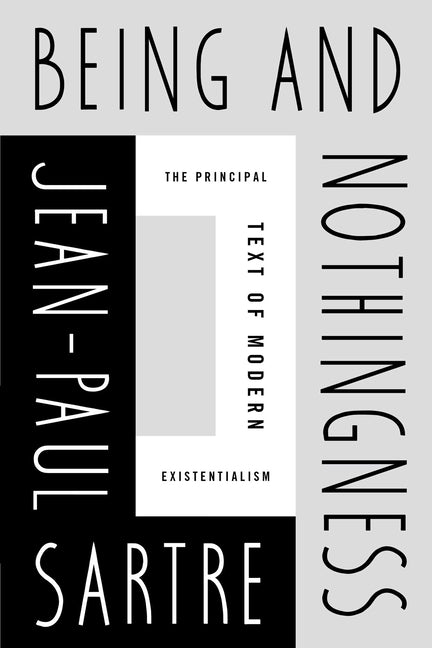
Jean-Paul Sartre
Being and Nothingness
Being and Nothingness
Couldn't load pickup availability
Jean-Paul Sartre's monumental masterpiece of existentialist philosophy—a profound and systematic exploration of human consciousness, freedom, and existence demonstrating that we are radically free, condemned to choose ourselves in every moment, and responsible for creating meaning in a universe without inherent purpose, creating one of the most influential and challenging works of twentieth-century philosophy.
Jean-Paul Sartre (1905-1980), French philosopher, novelist, and playwright, published Being and Nothingness (L'Être et le Néant) in 1943 during the Nazi occupation of France. Drawing on phenomenology (particularly Husserl and Heidegger), Sartre developed a comprehensive existentialist philosophy centered on human freedom and consciousness. The book's central thesis is radical: human beings are not defined by any fixed essence or nature but exist as pure freedom—we are what we choose to make of ourselves. This freedom is absolute and inescapable, making us entirely responsible for who we become and the meaning we create in our lives.
What you'll discover:
- Being-in-itself vs. being-for-itself—the fundamental distinction between things and consciousness
- Radical freedom—we are condemned to be free and responsible for our choices
- Bad faith—the ways we deceive ourselves to escape freedom and responsibility
- The look of the Other—how being seen by others shapes our self-awareness
- Nothingness and negation—consciousness as the power to negate what is
- Authenticity vs. inauthenticity—living in truth or self-deception
- Existence precedes essence—we create ourselves through our choices
- The anguish, abandonment, and despair of absolute freedom
Sartre distinguishes between being-in-itself (être-en-soi)—the mode of existence of things, which simply are what they are—and being-for-itself (être-pour-soi)—the mode of existence of consciousness, which is always aware of itself and free to choose. Things have essence; they are defined by what they are. But human consciousness has no fixed essence—we exist first and create our essence through our choices. This is the meaning of Sartre's famous phrase: existence precedes essence. We are not born with a predetermined nature but must choose who we become.
What makes this book essential for your contemplative library is its uncompromising vision of human freedom and responsibility. Sartre argues that we cannot escape freedom—even refusing to choose is a choice. This radical freedom brings anguish (the vertigo of realizing we must choose without any guarantee), abandonment (there is no God or fixed human nature to guide us), and despair (we cannot control the consequences of our choices). Yet this freedom is also the source of human dignity and authenticity—we are not determined by our past, our circumstances, or our biology but are always free to transcend what we have been and choose anew.
Sartre explores bad faith (mauvaise foi)—the ways we deceive ourselves to escape the burden of freedom. We pretend we are defined by our roles ("I'm just a waiter"), our past ("I can't change who I am"), or external circumstances ("I had no choice"). But these are lies we tell ourselves to avoid the anguish of freedom. Authenticity requires acknowledging our radical freedom and taking full responsibility for who we choose to become.
The book also explores the look of the Other—how being seen by another person transforms our self-awareness. When someone looks at me, I become aware of myself as an object in their world, not just a free subject. This creates conflict: I want to be free, but the Other's gaze threatens to reduce me to a thing. Sartre's famous analysis of shame, love, and interpersonal relations reveals how our relationships with others are fundamentally shaped by this tension between freedom and objectification.
Being and Nothingness is dense, challenging, and systematic—over 600 pages of rigorous phenomenological analysis. But it rewards careful reading with profound insights into consciousness, freedom, and what it means to be human. Sartre's vision is both liberating and terrifying: we are absolutely free, entirely responsible, and must create meaning in a universe that offers no inherent purpose or guidance.
The book has profoundly influenced existentialism, phenomenology, psychoanalysis, literary theory, and contemporary philosophy. It stands alongside Heidegger's Being and Time as one of the foundational texts of existential phenomenology and remains essential reading for anyone seeking to understand human freedom, consciousness, and authentic existence.
Perfect for: Readers of existentialist philosophy and phenomenology, students of Sartre, Heidegger, and continental philosophy, those interested in freedom, consciousness, and authenticity, readers of Dostoevsky and existentialist literature seeking philosophical grounding, students of philosophy of mind and consciousness, anyone grappling with questions of meaning, responsibility, and self-creation, contemplative readers drawn to radical freedom and authentic living, and seekers interested in what it means to exist without predetermined essence or purpose.
This paperback edition presents Sartre's monumental masterpiece—a profound exploration of human consciousness and radical freedom that remains one of the most influential works of twentieth-century philosophy.
Share