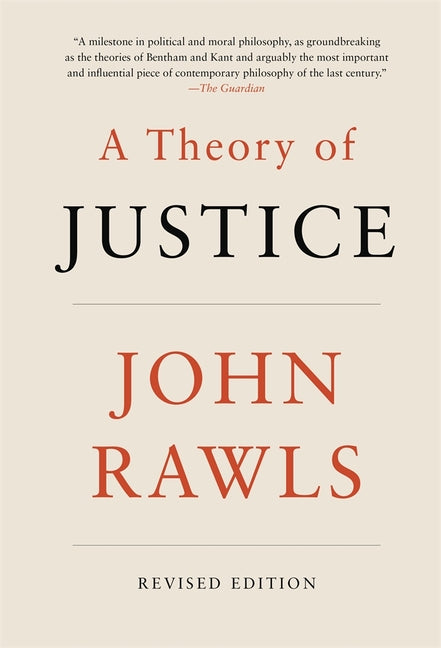
John Rawls
A Theory of Justice
A Theory of Justice
Couldn't load pickup availability
John Rawls's A Theory of Justice stands as the most influential work of political philosophy in the twentieth century, revitalizing the discipline and reshaping debates about fairness, equality, and the foundations of a just society.
First published in 1971 and revised by the author to address key questions raised by decades of scholarly engagement, this landmark text offers a systematic account of justice as fairness—a vision grounded in the social contract tradition of Rousseau, Kant, and Locke, yet thoroughly modern in its application to contemporary democratic societies.
What distinguishes Rawls's approach is his famous thought experiment: the "veil of ignorance." Imagine designing the basic structure of society without knowing your own position within it—your race, class, gender, talents, or beliefs. What principles would you choose? Rawls argues that rational individuals in this "original position" would select principles that protect basic liberties for all and arrange social and economic inequalities to benefit the least advantaged members of society.
Key Themes:
- Justice as fairness and the social contract tradition
- The veil of ignorance and the original position
- Two principles of justice: equal basic liberties and fair equality of opportunity
- The difference principle: inequalities must benefit the least advantaged
- Critique of utilitarianism and alternative frameworks for justice
- The relationship between individual rights and the common good
- Stability, legitimacy, and the well-ordered society
Why This Text Matters:
Rawls's work provides a philosophical foundation for liberal democracy that transcends partisan politics. His central claim—that "each person possesses an inviolability founded on justice that even the welfare of society as a whole cannot override"—offers a powerful defense of human dignity and individual rights while addressing questions of economic fairness and social cooperation. The theory has influenced constitutional law, public policy, and moral philosophy across the globe.
This revised edition incorporates Rawls's own clarifications and refinements, making his complex arguments more accessible while preserving their rigor and depth.
Ideal for: Students of political philosophy, scholars of justice and ethics, political theorists, policymakers, legal scholars, and anyone seeking a systematic framework for thinking about fairness, equality, and the principles that should govern a just society.
Quality paperback edition. An essential cornerstone of any serious political philosophy library.
Share